
Delhi has been the seat of power for more than a dozen empires. That kind of history does not disappear, it sits in stone, brick, and iron, right in the middle of the city. For students, this makes Delhi one of the most useful places to visit in all of India.
No textbook can replace standing inside a Mughal fort or looking up at a 73-metre minaret. This guide covers the best historical places in Delhi for students, what they will learn there, and what to keep in mind before visiting.
Why Delhi Works So Well for Educational Visits
Delhi has been the capital of the Delhi Sultanate, the Mughal Empire, the Maratha Confederacy, and British India. Each ruler left behind something physical a fort, a mosque, a tomb, a garden. This is unusual. Most cities have history from one or two eras. Delhi has it from all of them.
Students studying Indian history, architecture, political science, or even science and astronomy will find something directly relevant here. The city makes abstract topics concrete in ways that classroom lectures simply cannot.
The Best Historical Places in Delhi for Students
1. Red Fort (Lal Qila) – Inside the Mughal Court
The Red Fort was built by Mughal Emperor Shah Jahan in 1639. It served as the royal residence of the Mughal emperors for nearly 200 years and is now a UNESCO World Heritage Site.
Inside the fort, students can walk through the Diwan-i-Aam (Hall of Public Audience), the Diwan i Khas (Hall of Private Audience), and several Mughal-era palaces. These structures show how Mughal architecture blended Persian, Timurid, and Indian styles into something that had never existed before.
The Sound and Light Show held in the evenings narrates the history of the fort through storytelling and projections. Many school groups visit specifically for this, it is educational without feeling like a lecture.
On 15 August every year, the Prime Minister of India addresses the nation from the fort’s ramparts. Students who know that fact often look at the place differently once they are standing there.
- Entry Fee: ₹35 (Indians) | ₹500 (Foreign nationals)
- Closed: Mondays
- Best Time to Visit: October to March
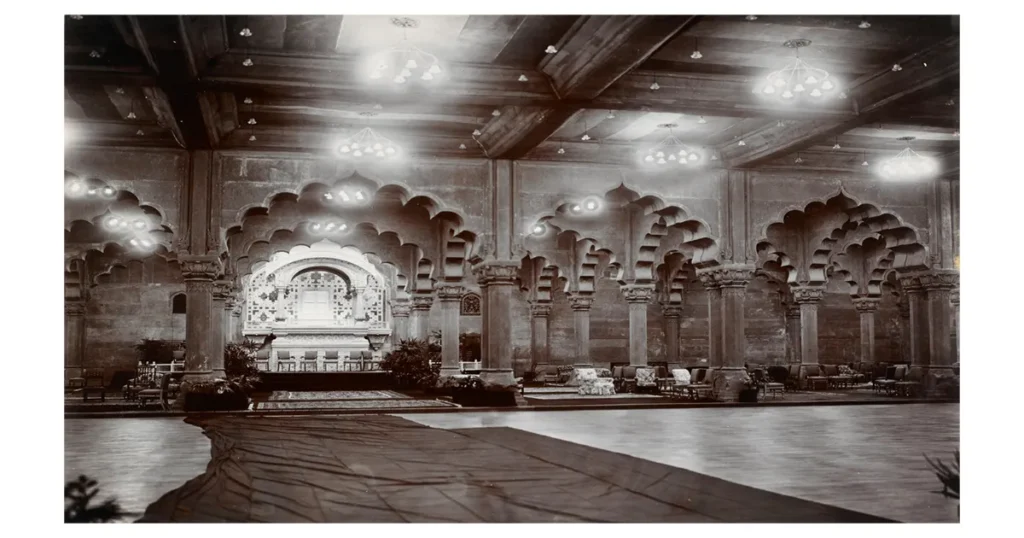
2. Qutub Minar – A Study in Stone and History
Qutub Minar is one of the tallest brick minarets in the world 73 metres high, built in the early 13th century by Qutb ud-Din Aibak, the founder of the Delhi Sultanate. It is also a UNESCO World Heritage Site.
The Qutub Minar Complex includes several structures that tell different parts of the same story. The Quwwat-ul-Islam Mosque, built using materials from demolished Hindu and Jain temples, reflects the political transitions of the period. The Alai Darwaza, added later by Alauddin Khilji, is one of the earliest examples of true arched construction in India.
The Iron Pillar inside the complex is from the 4th–5th century CE and has not rusted in over 1,600 years. Scientists still study it. For students interested in ancient Indian metallurgy, that one object could spark a genuinely interesting research project.
- Entry Fee: ₹40 (Indians) | ₹600 (Foreign nationals)
- Best Time to Visit: Morning, before the crowds arrive
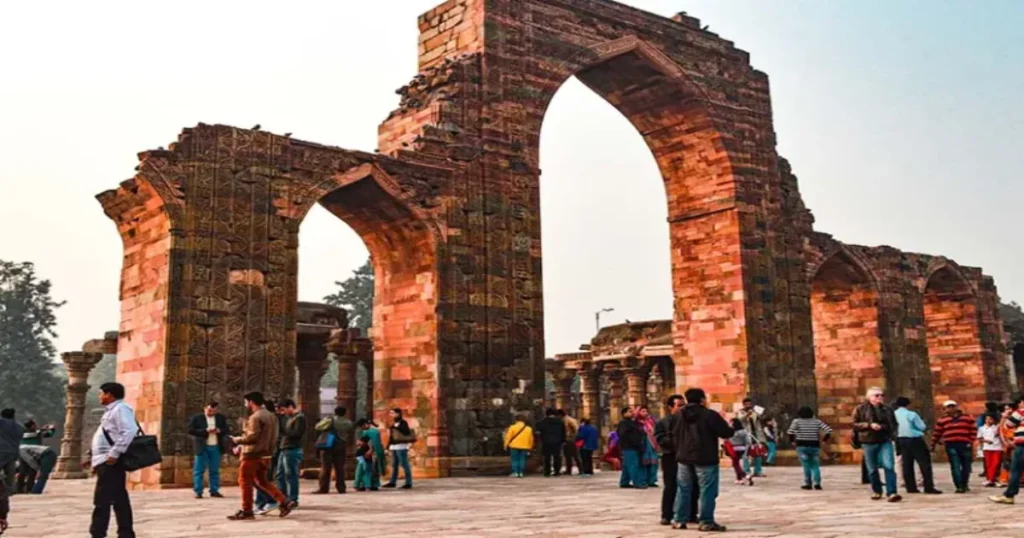
3. Humayun’s Tomb – The Tomb That Influenced the Taj Mahal
Humayun’s Tomb was completed in 1570. It was built by Humayun’s widow, Bega Begum, and is widely considered the first major garden-tomb on the Indian subcontinent. It is also a UNESCO World Heritage Site.
Many historians and architects believe the Taj Mahal design was directly influenced by Humayun’s Tomb. Visiting both sites gives students a clear visual understanding of how Mughal architecture developed over about a century.
The complex includes a large Persian-style char bagh garden (a garden divided into four quadrants by water channels), as well as several smaller tombs. This makes the site useful for students studying garden design, landscape history, or Mughal culture.
Entry Fee: ₹40 (Indians) | ₹600 (Foreign nationals)
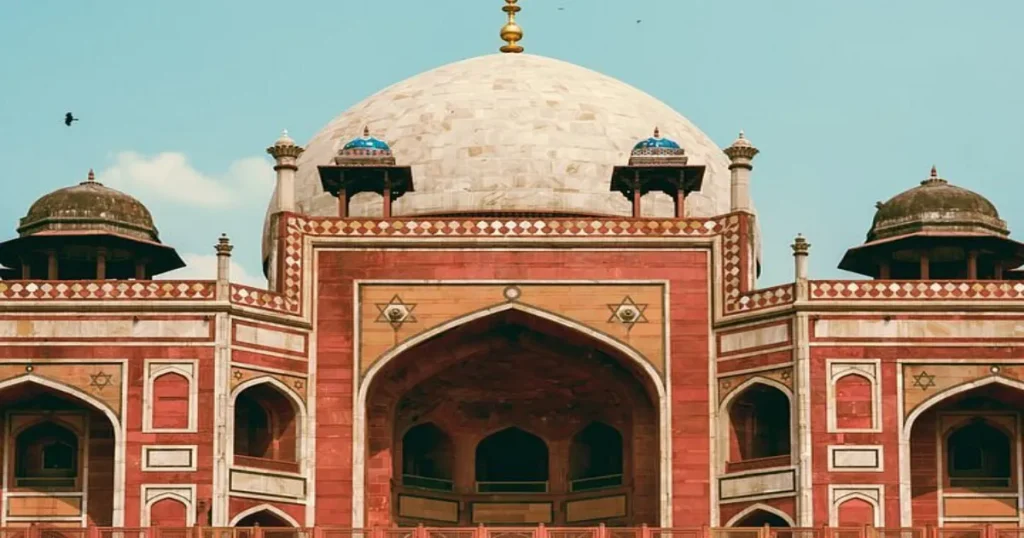
4. India Gate – A War Memorial With a Story Attached
India Gate was built in 1931 by the British government to honour the approximately 70,000 Indian soldiers who died in World War I and on the Afghan frontier. More than 13,000 names are inscribed on its walls.
For students studying Indian colonial history or military history, the memorial puts something abstract war casualties into a human context. Reading names on a wall is different from reading a number in a book.
India Gate sits at the end of Kartavya Path (formerly Rajpath), the ceremonial boulevard used during Republic Day parades every 26 January. Students who have seen the parade on television often find it striking to stand at the actual location.
The Amar Jawan Jyoti, an eternal flame beneath the arch, was originally lit in 1972. In 2022, it was merged with the flame at the National War Memorial nearby.
- Entry Fee: Free
- Best Time to Visit: Evening, when the monument is lit up
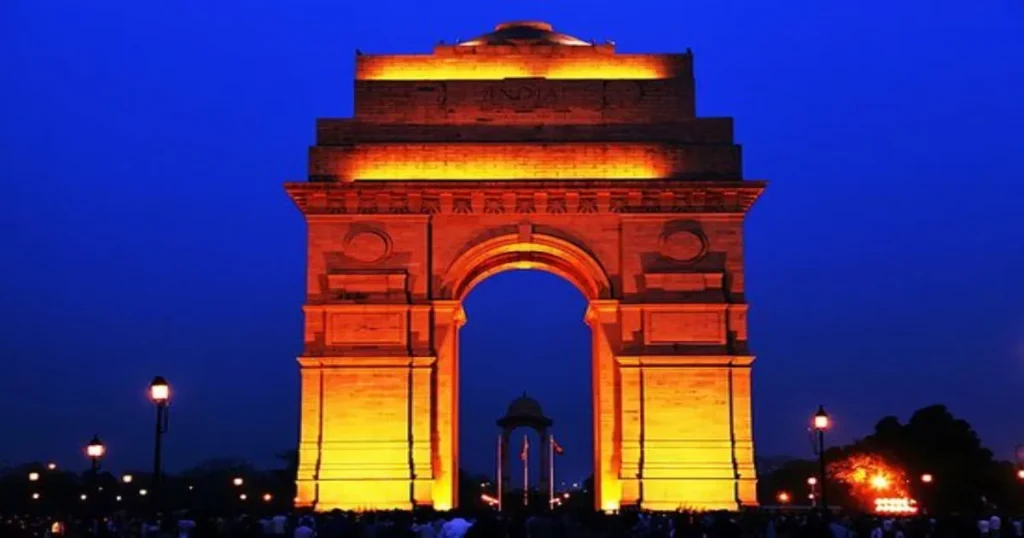
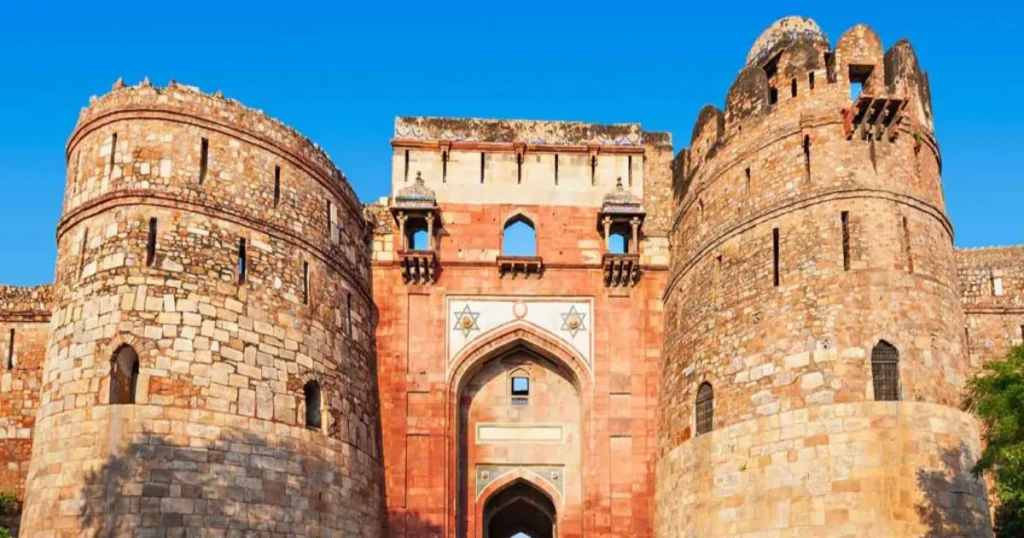
5. Purana Qila (Old Fort) – Delhi’s Layered Past
Purana Qila is sometimes called the Old Fort of Delhi. Emperor Humayun began construction, and Sher Shah Suri completed it in 1545 after defeating Humayun and taking control of the Mughal territories.
The fort sits on a site that many historians associate with Indraprastha, the legendary city of the Mahabharata. Archaeological excavations at the site have found pottery from the Painted Grey Ware period (around 1000 BCE), which adds an extra layer to any student visit.
Inside the fort, the Qila-i-Kuhna Mosque and the Sher Mandal an octagonal tower are the main structures still standing. The on-site Archaeological Museum displays excavated artefacts and gives context to what students are looking at.
This is one of the more underrated historical monuments in Delhi for students, partly because it is less crowded than the Red Fort or Qutub Minar.
- Entry Fee: ₹25 (Indians) | ₹300 (Foreign nationals)
- Closed: Fridays
6. Jama Masjid – Scale and Craft in One Place
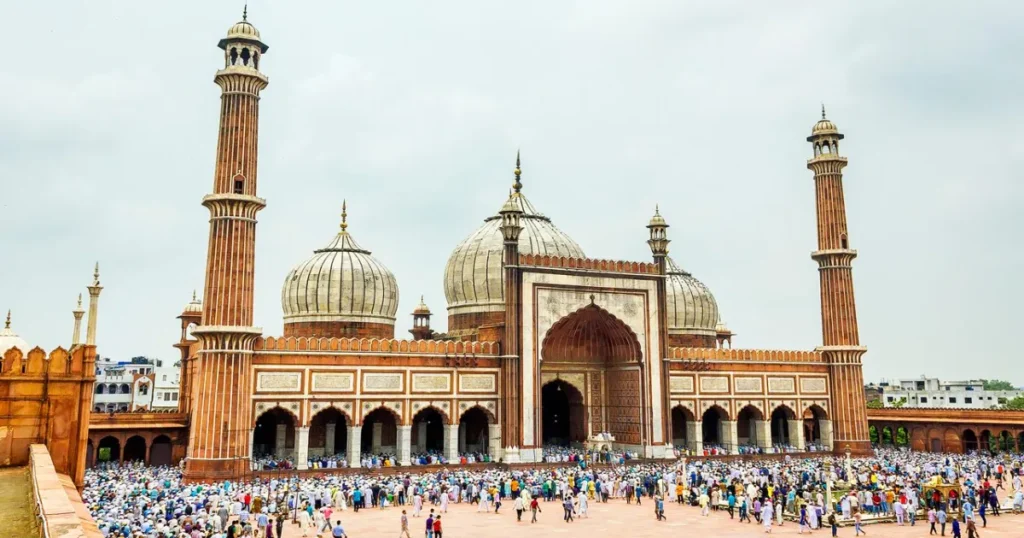
Jama Masjid is India’s largest mosque. Shah Jahan built it between 1644 and 1656, and it can accommodate around 25,000 worshippers at a time. The courtyard alone is large enough that the scale is hard to take in from ground level.
Students of architecture will notice the balance between the three domes, two minarets, and the broad staircases leading to the main gate. The construction involved red sandstone and white marble the same materials used in many Mughal structures of the period.
Climbing one of the minarets gives a direct aerial view of Old Delhi, which helps students understand how the Mughal city was laid out. It is one of the few places in Delhi where students get that kind of perspective.
- Entry Fee: Free (camera charges apply)
- Best Time to Visit: Outside of prayer times
7. Chandni Chowk – History That Is Still Alive
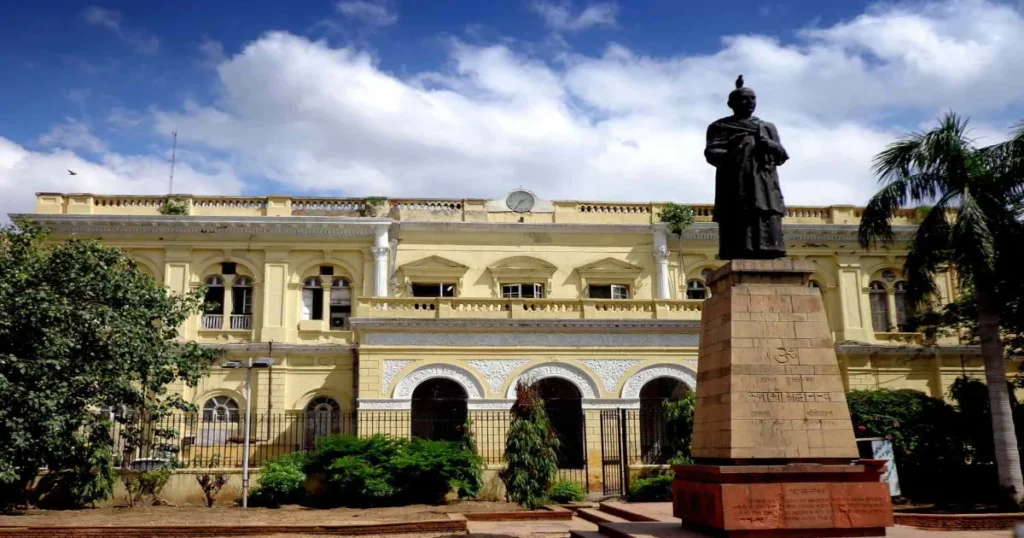
Chandni Chowk is not a monument. It is a market but one of the oldest functioning markets in Asia, designed by Mughal princess Jahanara Begum in the 17th century.
Walking through Chandni Chowk, students pass centuries-old havelis, gurdwaras, mosques, temples, and small shops that have been in the same families for generations. The Lahori Gate of the Red Fort marks the starting point of this area. The Fatehpuri Mosque sits at the far end of the main street.
This is a good place for students studying social history, trade, or urban planning to see how a Mughal-era commercial district actually functions and has continued to function over hundreds of years.
- Entry Fee: Free
- Best Time to Visit: Weekday mornings
8. Jantar Mantar – Science Built Into the Architecture
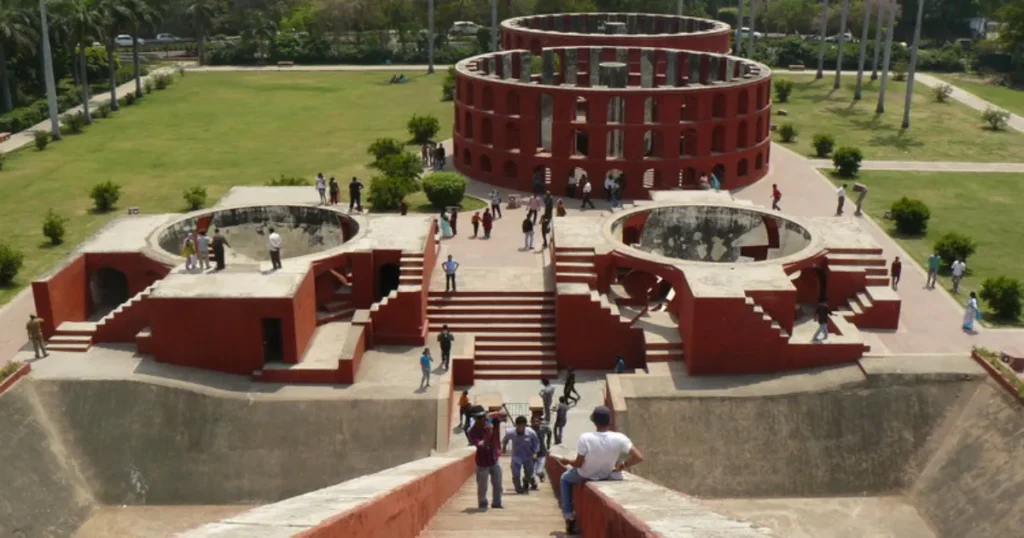
Jantar Mantar in Delhi is one of five astronomical observatories built by Maharaja Jai Singh II of Jaipur in the early 18th century. The structures in the complex are not just buildings, they are instruments for measuring time, predicting eclipses, and tracking celestial bodies.
The Samrat Yantra (Supreme Instrument) inside the observatory functions as a giant sundial. On a clear day, it can measure time to an accuracy of two seconds.
For science students, this is one of the most directly relevant historical places in Delhi. It shows that India had advanced knowledge of mathematics and astronomy long before the colonial period. It also challenges the common assumption that scientific thinking in India only developed through European influence.
Entry Fee: ₹25 (Indians) | ₹300 (Foreign nationals)
9. Lodhi Garden – Delhi Sultanate Tombs in a Park
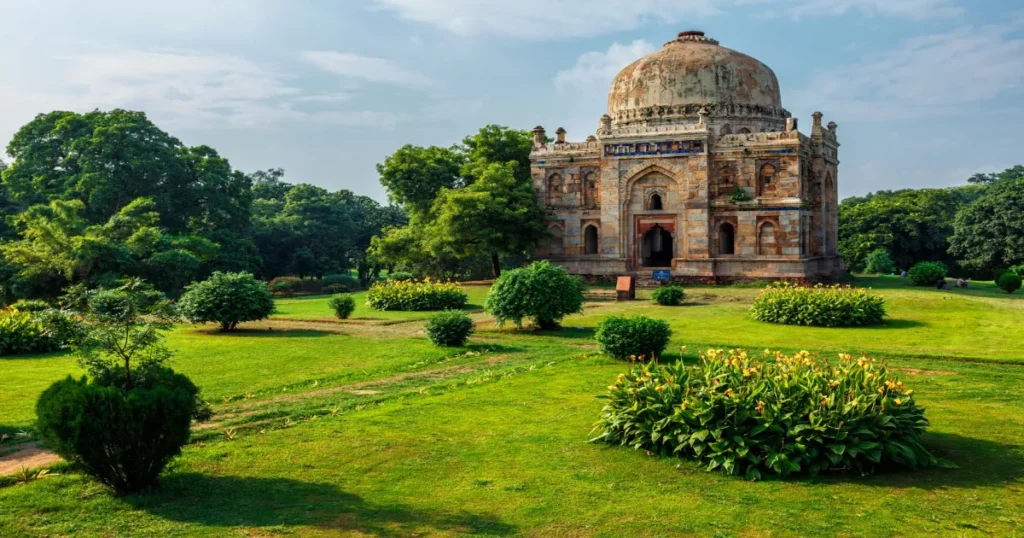
Lodhi Garden is a 90-acre green park in central Delhi that contains the tombs of Sayyid and Lodi dynasty rulers from the 15th and 16th centuries the period just before the Mughal Empire was established.
The main structures inside the garden are the Muhammad Shah’s Tomb, Bara Gumbad (a large dome), Shish Gumbad (a tile-covered tomb), and the Sikander Lodi’s Tomb. Each shows a different stage of pre-Mughal Delhi architecture.
Students studying the transition between the Delhi Sultanate and the Mughal period will find the tombs here useful. The garden also gives groups a place to sit, discuss, and take notes something not always easy at busier monuments.
- Entry Fee: Free
- Best Time to Visit: Early morning
10. Safdarjung’s Tomb – The End of an Era
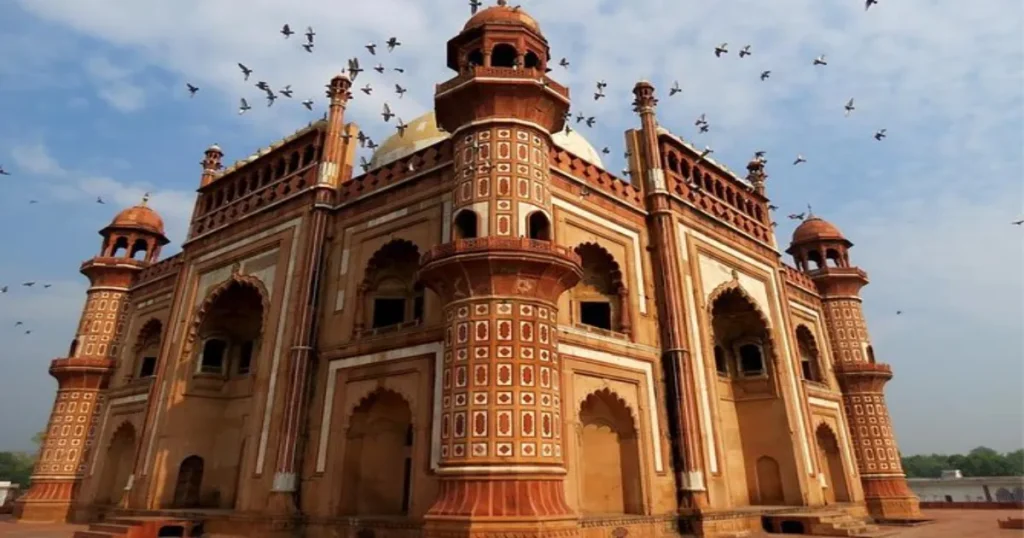
Safdarjung’s Tomb was built in 1754 for Mirza Muqim Abul Mansur Khan, better known as Safdarjung, who served as Prime Minister to Mughal Emperor Ahmad Shah. It is often described as the last major garden-tomb of the Mughal period in Delhi.
The tomb was built when the Mughal Empire was clearly in decline. The quality of craftsmanship is notably lower than Humayun’s Tomb, built roughly 180 years earlier. Students who visit both sites can trace that architectural decline with their own eyes.
The surrounding garden follows the same char bagh design as Humayun’s Tomb but feels less precise. Comparing the two is a useful exercise for students studying how political and economic decline shows up in art and architecture.
- Entry Fee: ₹25 (Indians) | ₹300 (Foreign nationals)
- Closed: Fridays
Practical Tips for Student Groups Visiting Delhi
Visiting Delhi’s historical monuments with a group of students takes some planning. Here are things worth knowing before the trip.
Footwear: Most sites involve uneven surfaces, stone floors, and long walks. Comfortable closed shoes are a better choice than sandals or heels.
Water and food: Outside vendors are available near most monuments, but carrying water is a good habit, especially during summer months.
Timing: Most Delhi historical sites are open from 6 AM or 7 AM. Arriving early means better light for photos and far fewer crowds. By 11 AM, popular sites like the Red Fort and Qutub Minar get busy.
Guide or audio tour: A guide who knows the site adds context that general descriptions miss. Several monuments also offer audio guides, which are useful for student groups that want to explore at their own pace.
Check weekly closures: Purana Qila, Safdarjung’s Tomb, and several other sites close on Fridays. The Red Fort is closed on Mondays. It is worth checking before building the itinerary.
Documentation: Students who are writing reports or preparing school projects should take notes or photographs during the visit. Most monuments allow photography without a fee, but some charge for video.
Best Time to Visit Historical Places in Delhi
October to March is the ideal window. Temperatures are manageable, the air quality is better, and the sites are easier to walk around. December and January can get cold in the evenings, so carrying a light jacket helps.
April to June is hot often above 40°C and makes long outdoor visits uncomfortable. July to September brings the monsoon. Some sites become muddy, and walking paths can get slippery.
For school trips especially, November to February tends to work best. Republic Day (26 January) brings crowds to Kartavya Path and India Gate, so it is worth keeping that in mind when planning dates.
What Students Actually Learn From These Visits
There is a difference between reading “the Mughal Empire lasted from 1526 to 1857” and standing inside a fort built by the Mughal emperors. Both matter, but they work differently.
At Qutub Minar, students see physical evidence of the transition from pre-Islamic to early Islamic rule in Delhi not as a political narrative but as a collection of actual objects: carvings, columns, inscriptions. At Jantar Mantar, they see that Indian rulers were funding scientific research in the 1700s. At Safdarjung’s Tomb, they can observe what decline looks like in stone.
This kind of experiential learning tends to stick. The specific dates and names may fade after an exam, but the physical experience of the place usually does not.
A Suggested Two-Day Itinerary for Students
Day 1 – Old Delhi Focus
- Morning: Red Fort (with audio guide or licensed guide)
- Mid-morning: Walk through Chandni Chowk toward Fatehpuri Mosque
- Afternoon: Jama Masjid
- Evening: Sound and Light Show at Red Fort (if returning)
Day 2 – South Delhi Monuments
- Morning: Qutub Minar Complex
- Afternoon: Humayun’s Tomb
- Late afternoon: Lodhi Garden
- Optional add-on: Safdarjung’s Tomb (just across the road from Lodhi Garden)
Jantar Mantar and Purana Qila can fit into either day depending on the group’s pace. India Gate works as an evening stop the lighting after sunset makes it a good endpoint.
Entry Fees at a Glance
| Monument | Indian (₹) | Foreign (₹) | Closed On |
|---|---|---|---|
| Red Fort | 35 | 500 | Monday |
| Qutub Minar | 40 | 600 | Open daily |
| Humayun’s Tomb | 40 | 600 | Open daily |
| India Gate | Free | Free | Open daily |
| Purana Qila | 25 | 300 | Friday |
| Jama Masjid | Free | Free | During prayers |
| Jantar Mantar | 25 | 300 | Open daily |
| Lodhi Garden | Free | Free | Open daily |
| Safdarjung’s Tomb | 25 | 300 | Friday |
| Chandni Chowk | Free | Free | Open daily |